Baykar’s Bayraktar AKINCI unmanned combat aerial vehicle (SİHA) has completed an airborne release test with the ORKA next-generation lightweight torpedo developed by Türkiye’s ROKETSAN.
Baykar announced the test on 22 November 2026 in a social media post titled “ORKA Next-Gen Lightweight Torpedo Firing Test.”
According to Türkiye's state-owned Anadolu Agency, AKINCI took off from the Çorlu Flight Training and Test Center in Tekirdağ carrying the torpedo. During the test in the Gulf of Saros, ORKA was safely released from an underwing station and entered the water at the designated point. AKINCI subsequently returned to Çorlu.
The test was described as the first release of ORKA from an unmanned aerial platform. Publicly available information confirms the separation and water-entry phases, but does not provide details of a scenario in which the torpedo searched for, tracked or engaged an underwater target. The test should therefore be viewed as a milestone in platform–weapon integration, rather than as a demonstration of a complete submarine engagement.
ORKA expands the range of weapons available to unmanned platforms
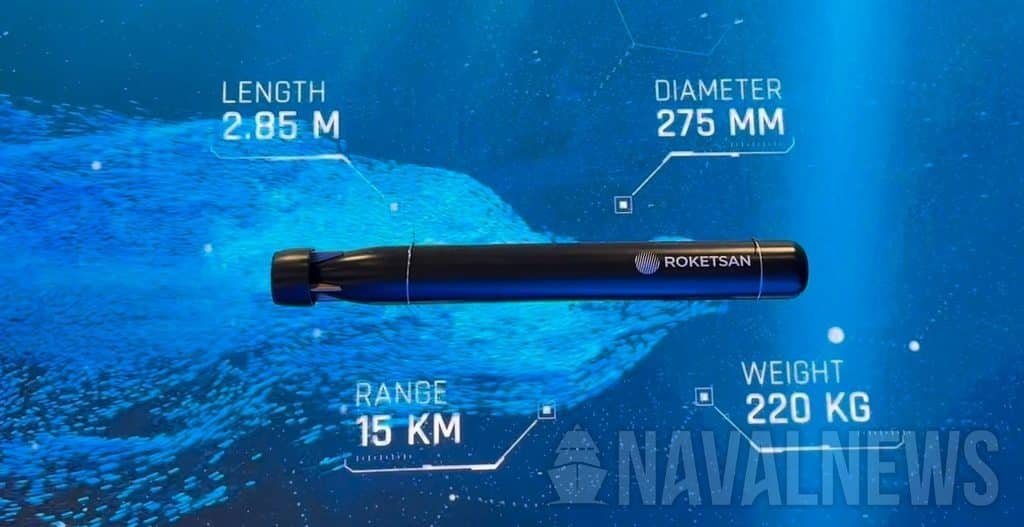
Roketsan's ORKA torpedo demonstration at IDEF 2025
Developed by ROKETSAN, ORKA is a lightweight torpedo designed for use against submarine targets. It can be launched from surface platforms and aircraft, and uses an active/passive sonar seeker for target detection and an onboard guidance system to home in on its target.
The release test from AKINCI is significant because it expands the aircraft’s potential mission set into the underwater-warfare domain. However, safely carrying and releasing a torpedo is not the same as demonstrating an operational ASW capability. A complete engagement chain also requires detecting and classifying a contact, establishing its position with sufficient accuracy, and passing usable targeting data to the weapon platform.
Türkiye’s recent sonobuoy activities with unmanned aircraft represent steps toward developing the sensor side of that chain.
Sonobuoy trials precede torpedo integration
In September, during the Denizkurdu-I/2026 exercise, Bayraktar TB3 took off from TCG Anadolu and used Baykar’s Sonobuoy Delivery System, SAS POD.
TB3 SİHA released two sonobuoys and processed data from both its own sonobuoys and those deployed by a maritime patrol aircraft operating in the exercise. The resulting underwater data was also displayed in real time during the exercise.
AKSUNGUR has also taken part in sonobuoy activities. During the Mavi Balina-2026 exercise in November, reports said that TB3 and AKSUNGUR’s ASW capabilities were tested, with work focused on sonobuoy deployment and acoustic-signal processing.
Taken together, these activities show that the role of unmanned aircraft in ASW is expanding beyond long-endurance surveillance. Carrying and deploying sonobuoys, processing acoustic data and now releasing a torpedo point to the gradual transfer of individual tasks traditionally performed by crewed maritime patrol aircraft to unmanned systems.
ORKA lightweight torpedo fitted to AKINCI SİHA (Screenshot from Baykar video)
Naval News comments
AKINCI’s ORKA release test is an important development for unmanned ASW. Its significance lies not simply in giving a UAV a new weapon, but in opening the weapon-delivery phase of submarine hunting to unmanned aerial platforms. Turkish Navy's UAVs can already conduct long-endurance intelligence, surveillance and reconnaissance (ISR) missions; they are now moving into another part of the maritime patrol mission set.
Airborne platforms are among the most challenging threats for submarines. A submarine can use weapons against a surface ship or another submarine, but its options for responding to an aircraft while remaining submerged are extremely limited. Submarine-launched air-defence systems such as IDAS are intended to address this imbalance. However, such systems have yet to become a widely operational capability, leaving airborne threats a major concern for submarines.
The endurance of unmanned aircraft could make that challenge more persistent. AKSUNGUR’s long-duration ISR missions, the sonobuoy activities involving TB3 and AKSUNGUR, and AKINCI’s torpedo-release test together point towards a structure in which unmanned aircraft could support different phases of ASW. These tasks do not necessarily need to be carried out by a single platform: one aircraft could deploy or process sensors, while another carries the weapon.
A successful release test, however, does not by itself establish an end-to-end operational ASW capability. Reliable acoustic-contact classification, the generation of targeting-quality data and the decision to engage remain essential parts of the process.
The broader direction is that an increasing share of maritime air missions could be performed by unmanned systems. This will not eliminate the human role, but it can reduce the impact of crew endurance limits and help sustain operations for longer periods. In the near term, the most significant effect is likely to be a redistribution of workloads—not the complete replacement of crewed maritime patrol aircraft. Unmanned platforms could take on more persistent search and surveillance tasks, allowing crewed aircraft to focus on missions that require their capabilities.
The post Bayraktar AKINCI Conducts First ORKA Torpedo Release Test appeared first on Naval News.
Savunma360 Stratejik ve Teknik Değerlendirme (Deniz Sistemleri)
Deniz yetki alanlarında (Mavi Vatan ve açık deniz görev kuvvetlerinde) suüstü hava savunma harbi, denizaltı savunma harbi (DSH) ve otonom insansız deniz araçlarının (İDA) entegrasyonu stratejik öncelik taşımaktadır. Bayraktar AKINCI Conducts First ORKA Torpedo Release Test başlığındaki bu adım, donanma görev gruplarının açık deniz harekât yarıçapını ve angajman etkinliğini artırmaktadır.