Connecting adaptable naval platforms, underwater systems and layered protection offers a more flexible response to threats that no longer respect the waterline.
Sponsored by

A maritime challenge across domains
Maritime security is no longer defined solely by the contest between fleets. A naval base may face aerial drones, fast surface craft, combat divers and underwater vehicles, while the cables and pipelines beyond its perimeter remain exposed to disruption. The challenge is therefore to protect ships, critical undersea infrastructure, vital Sea Lines of Communication (SLOCs) and maritime chokepoints through a coherent capability spanning the surface, underwater, air and digital domains. In this context, effective and persistent Underwater Situational Awareness is essential to extending Maritime Situational Awareness beneath the waterline, enabling the timely detection, identification and monitoring of potential threats and activities of interest, while supporting freedom of navigation, mobility and the continuity of global trade.
Small, low-cost uncrewed systems can impose disproportionate demands on sensors and operators. Quiet underwater contacts require different detection methods from fast craft concealed in harbour traffic or low-flying drones. No single sensor or platform can resolve every threat; the response must combine complementary sensing, mobile inspection and proportionate action.
The naval platform as a capability vector
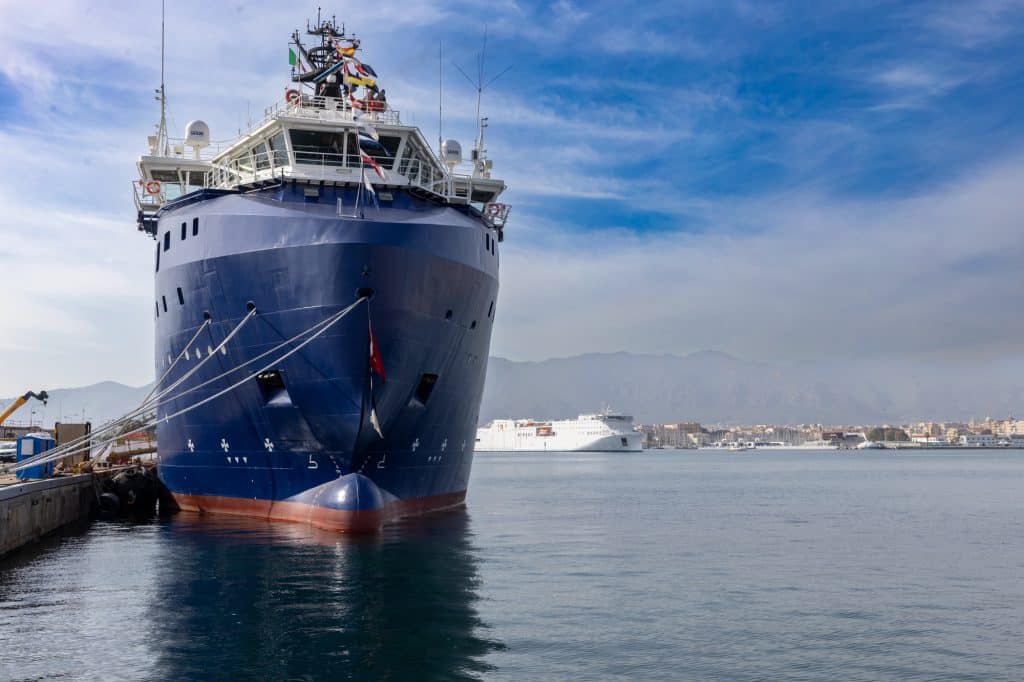
This environment gives renewed importance to the naval platform as a vector: a mobile carrier that transports, connects and sustains mission capabilities. The hull supplies endurance, seakeeping, power, communications and human support. Mission kits determine the operational emphasis, allowing the same platform to undertake different tasks without becoming a new ship each time.
Such platforms complement rather than replace frigates, submarines and specialist vessels. They can provide tailored presence and extend surveillance, preserving high-end combatants for tasks requiring greater survivability, sustained combat power or specialised performance.
From mobile systems to layered protection
Fincantieri’s underwater strategy aims to establish the first vertically integrated operator across the entire underwater value chain. In July 2026, the Group signed agreements to acquire majority stakes in Next Geosolutions, WSense, Graal Tech and Defcomm, creating a unique portfolio of capabilities spanning marine survey, underwater sensing and communications, robotics and uncrewed surface vehicles (USVs).
The DEEP and DEEP 4D concepts extend the vector-based approach from the individual ship to the protected site. DEEP is a modular, scalable and cyber-secure “system of systems” designed to protect critical infrastructure. It is built around a fixed underwater sensing core that combines passive acoustic early-warning capabilities with diver-detection sonar, all coordinated through an Underwater Management System (UMS).
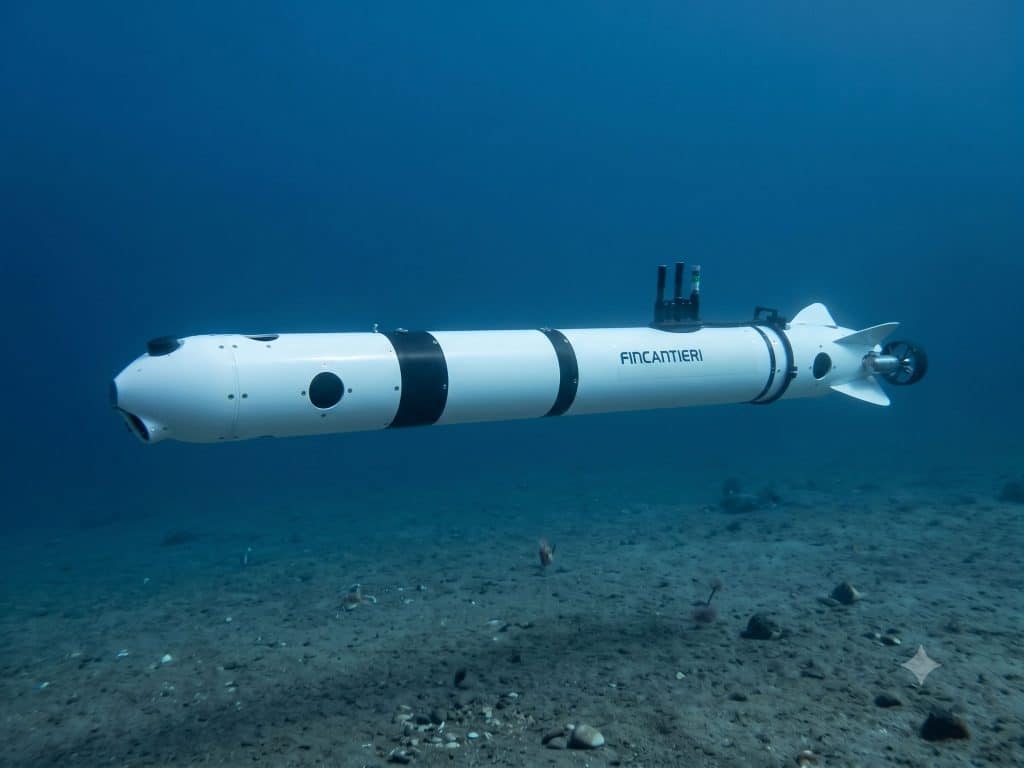
Mobile systems add a different function: investigating contacts rather than merely detecting them. Autonomous underwater vehicles (AUVs) can inspect harbour approaches, map access channels and record seabed conditions. Surface vehicles can support observation, communications and underwater-vehicle deployment. Examples, already integrated into the DEEP system, include Graal Tech’s X300 AUVs, the IDS’ Catcher surface platforms, and Defcomm’s Raptor USVs, which provide high-speed, long-range capabilities.
DEEP 4D brings the underwater protection concept together with surface and aerial awareness. Additional sensors contribute air and surface surveillance, while electro-optical and infrared systems can support visual confirmation. The exact combination of sensors and mobile vehicles depends on the configuration.
The operational value lies in connecting fixed persistence with mobile reach. Shore installations can maintain surveillance around critical assets, while a suitably equipped naval vessel carries inspection capability beyond the fixed perimeter. Together, they offer a scalable approach to naval-base security, port protection and monitoring of offshore energy and telecommunications infrastructure.
One operational picture, accountable decisions
The UMS provides the coordinating layer: correlating threats, managing alarms, supporting mission tasking and helping operators interpret information. Open digital interfaces provide an integration path towards naval command systems, vessel-traffic services and other security sensors, although integration remains an engineering task.
Connectivity also differs above and below water. Radio networks can link surface assets and shore nodes; underwater vehicles rely on more constrained acoustic communications, with short-range links or docking supporting larger data transfers. The architecture must therefore remain useful without continuous, high-bandwidth connectivity.
Automation should reduce workload without obscuring responsibility. Operators must retain authority over responses, supported by reliable information and clear operating procedures. Cybersecurity, resilient navigation and degraded-mode operation are essential to maintaining that control.
Underwater protection cannot succeed in isolation if the supporting base, vessel or control station remains vulnerable to aerial and surface attack. For a naval force, the significance is architectural: underwater inspection and surface or air defence should reinforce the same protection mission.
From modular equipment to operational capability
A credible mission kit includes more than its principal sensor or vehicle. Launch and recovery, power, cooling, data connections, maintenance, trained operators and certification are integral to the capability. Underwater operations introduce additional demands involving navigation accuracy, acoustic conditions, station-keeping and safe recovery. These constraints must shape both the platform and its payload configuration.
Mission breadth also has a cost. Combining several kits can reduce endurance, available space or specialist capacity for each task. Modularity must therefore be expressed through validated configurations and clear performance boundaries.
Turnkey delivery should mean an integrated, supportable capability: site assessment, interface engineering, training, acceptance trials and through-life assistance, not simply bundled hardware. Demonstrations can establish elements of integration, but coverage, communications and operational suitability still require validation for the intended location and mission.
The industrial opportunity is to connect shipbuilding strength with underwater sensing, robotics, digital integration and lifecycle services. Navies can gain a force that can evolve through payload and software upgrades while retaining a durable platform foundation. From naval to underwater capabilities is therefore not a move away from the ship: it is an expansion of what the ship can enable, within an integrated maritime defence system.
The post From Naval to Underwater Capabilities appeared first on Naval News.