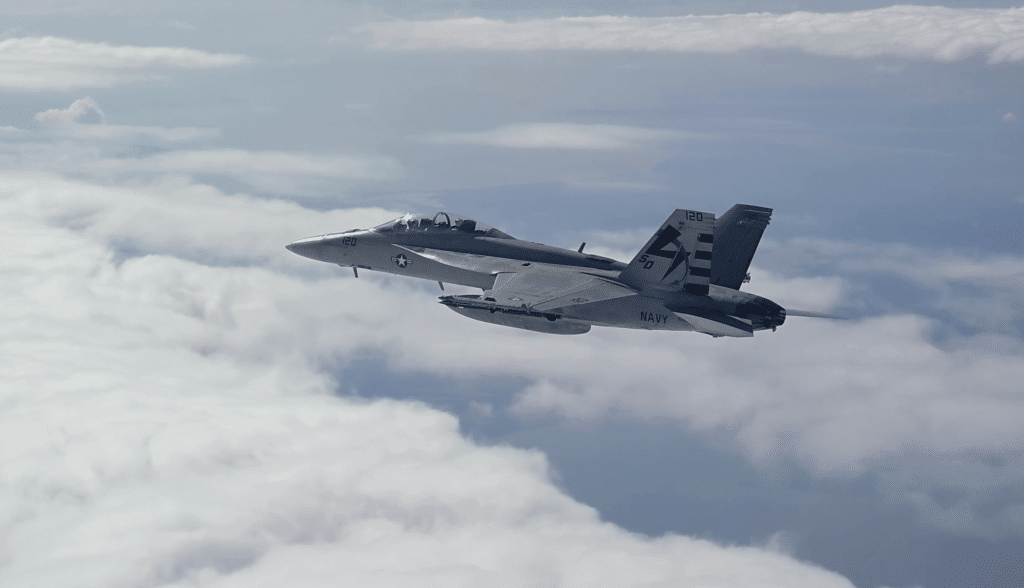
Chief of Naval Operations Adm. Daryl Caudle got an up-close look at the U.S. Navy’s new Blackbeard air-launched hypersonic missile during a visit to Naval Air Station Patuxent River, Maryland, on Oct. 28, offering a rare glimpse into the service’s efforts to develop new long-range strike capabilities for its carrier-based fighter fleet.
Caudle toured Air Test and Evaluation Squadron (VX) 23, where personnel briefed the Navy’s top officer on the Blackbeard missile, which was recently flight-tested aboard an F/A-18E/F Super Hornet at the installation, according to a U.S. Navy news release published Nov. 2. The hypersonic weapon touted its first hints at a designation, seen on the side as “AHM-XXX”.
The only other weapon known to have an “AHM” designation is the U.S. Air Force’s scramjet-powered Hypersonic Attack Cruise Missile, intended to enter limited service before the end of the decade. The “H” designation was newly added to the nomenclature system to identify tri-service hypersonic missiles.
Notably, the boost-glide AGM-183 Air-Launched Rapid Response Weapon does not feature an “H” designation.
The visit marks one of the Navy’s latest public acknowledgments of Blackbeard, a new air-launched weapon intended to expand the service’s long-range strike capabilities as it prepares for potential operations against increasingly sophisticated adversary air defenses. The Blackbeard platform is touted by its builder, Castelion, as a low-cost hypersonic strike weapon designed for rapid fielding and manufacturing.
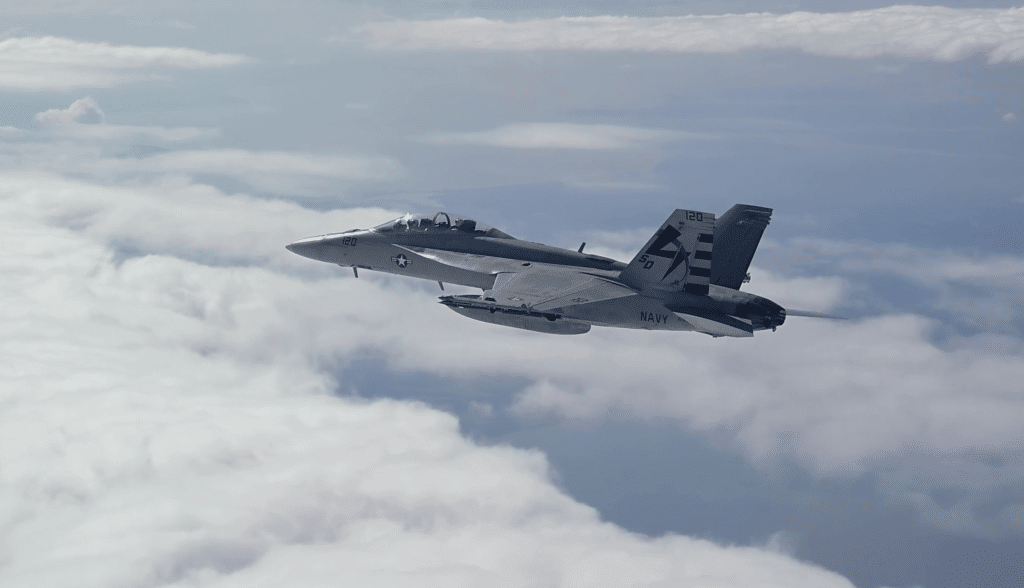
The Navy did not disclose additional details about the missile’s performance, flight-test objectives or development timeline in its announcement.
Caudle’s visit comes as the Navy seeks to modernize its carrier air wings with longer-range weapons and uncrewed aircraft capable of operating across vast distances, particularly in the Indo-Pacific, where China’s expanding arsenal of long-range missiles and sophisticated air defenses poses significant challenges to traditional carrier operations. Top service officials in the U.S. Navy and U.S. Air Force have stressed stealth, range, and standoff capability as defining elements of future air warfare — which Blackbeard can provide to the fourth-generation, non-stealth Super Hornet fleet.
“Developed by Castelion and led by the Portfolio Acquisition Executive Aviation (PAE(A)) through its Future Capability Development and Integration (FCD&I) Aviation Rapid Capabilities Cell, in coordination with the Naval Air Warfare Centers and the DON Rapid Capabilities Office, Blackbeard will provide carrier-based strike fighters with a responsive, high-speed strike option to pierce contested anti-access/area-denial (A2/AD) envelopes while significantly expanding theater magazine depth.”
U.S. Navy
The missile is part of a broader effort to expand the Navy’s long-range strike capabilities aboard its carrier-based fighter fleet, particularly as the service prepares for potential operations against increasingly sophisticated air defense systems fielded by in the Indo-Pacific, particularly China. The standoff strike capability delivered by Blackbeard would give Super Hornets a fighting chance at engaging targets defended by long-range missiles and high-end fifth-generation fighters, mixing into a suite of additional low-cost munitions under development for the U.S. Army, U.S. Marine Corps, and U.S. Air Force.
In Navy service, the Blackbeard joins a growing family of advanced weapons under development or in-production including the air-to-air AIM-174B, AIM-260A and AIM-424A, as well as anti-ship programs that include the Family of Affordable Mass Munition, Extended Range Attack Munition, JDAM-LR, and Coalition Heterogeneous Affordable Offensive Strike efforts.

Separately, the Navy is developing the Conventional Prompt Strike (CPS) hypersonic missile for deployment aboard surface combatants and submarines. Unlike Blackbeard, CPS is a much larger weapon intended to provide the fleet with a conventional long-range prompt strike capability against high-value targets.
The lines of effort, from high-end to low-end, represent a rearranging service-wide initiative looking to bring affordability and producibility to advanced weapons. After the U.S. Navy’s Hypersonic Air Launched Offensive missile was put on hold last April, the service turned to more affordable, accessible platforms designed for rapid fielding.
The post CNO Caudle Gets Up-Close Look at U.S. Navy’s Newest Hypersonic Missile appeared first on Naval News.