Analyzing Germany’s F127 frigate program, this article by German defense media hartpunkt examines why relying heavily on the U.S. Aegis technology and ecosystem may undermine national sovereignty and defense readiness.
By Lars Hoffman / hartpunkt
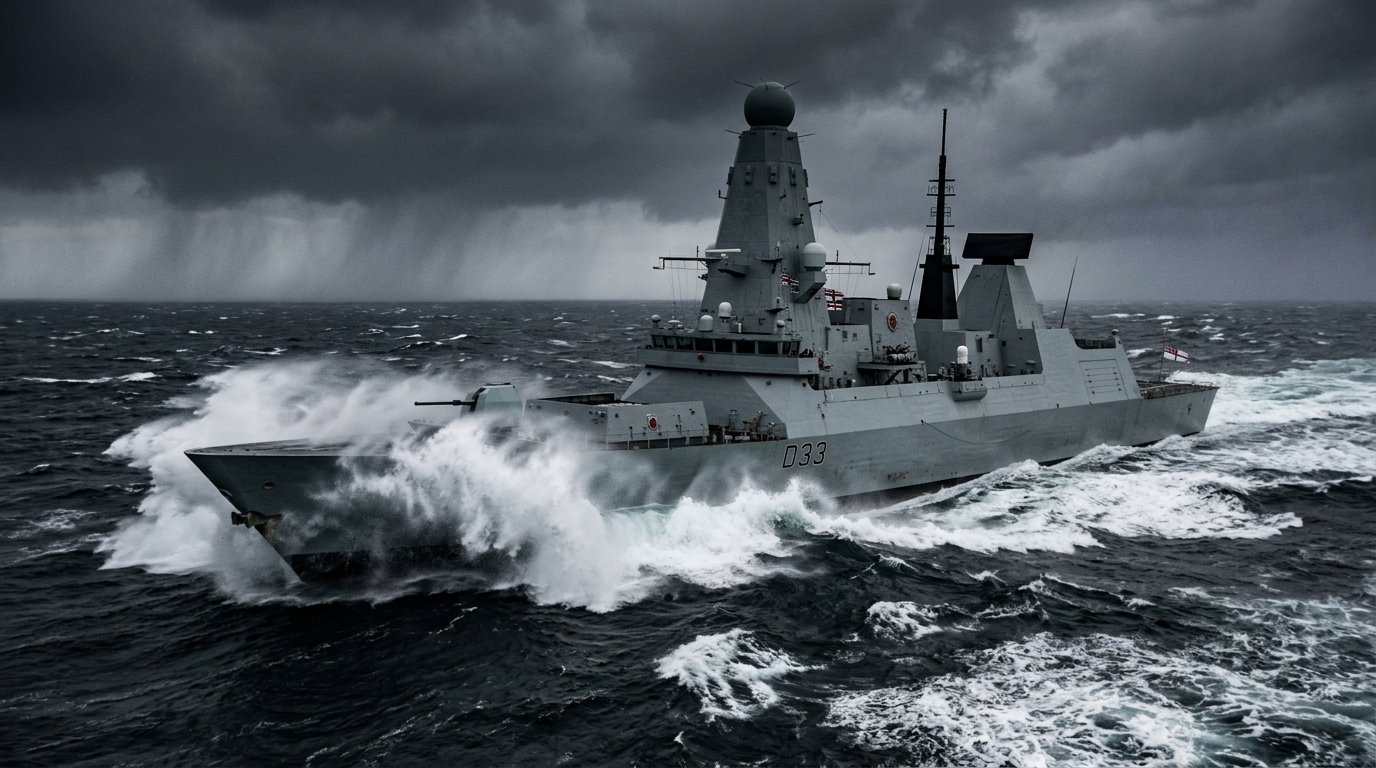
The German Navy’s future F127 class air defense frigates are intended not only for area air defense, but also for the even more demanding Ballistic Missile Defence (BMD) mission. To achieve this, current plans are to equip them with Aegis—arguably the most advanced Western combat management system for BMD—along with U.S.-manufactured sensors and effectors. In doing so, the Bundeswehr (German military) is closely aligning its configuration with the U.S. Navy’s Aegis “Program of Record.” For instance, the SPY-6 radar was selected over the alternative SPY-7 radar. This decision has been justified on the grounds that it is the only way to close the existing capability gap “at short notice,” as no capable European alternative is available, with the first ship scheduled to enter service around the middle of the coming decade.
The adoption of U.S. standards and the BMD capability also impacts structural requirements and is expected to cost several billion euros per ship. This has been criticized by some politicians as being too expensive, and the project currently appears to be under review.
Despite all the criticism regarding costs—though a cruiser-sized ship with the required capabilities is simply not cheap—it is easily overlooked that a comprehensive focus on the described U.S. of-the-shelf purchase brings a number of disadvantages that are likely to be just as politically difficult to communicate.
For example, purchasing technology selected and used by the U.S. Navy creates a high and potentially decades-long dependency on decisions made across the Atlantic. In case of doubt, the U.S. Navy dictates how the program proceeds, what modifications are made to the systems, and which weapons are to be integrated.
Choosing a purely U.S. configuration comes at a time when the United States is presenting itself as significantly more unpredictable, both politically and economically, than in past decades. Switzerland’s order for Patriot air defense systems serves as a good example here. After the administration under President Joe Biden had already ordered a reprioritization of the ordered PAC-3 guided missiles, the Trump administration last year summarily postponed the delivery of all five Swiss systems so that other countries could be prioritized.
While the Bundeswehr is currently benefiting from this decision because it can use the Swiss Patriots to replace contributions sent to Ukraine, it could soon find itself among the disadvantaged parties of such reprioritizations. Incidentally, Switzerland now anticipates a delay of at least six years. Thus, the argument that capability gaps can only be closed quickly using U.S. systems remains more of a hypothesis than a fact.
To the surprise of most experts, the USA has also expended such massive quantities of interceptor missiles of all classes in the ongoing, lingering Iran war that stockpiles have now dwindled dangerously. In the coming years, in accordance with the “America First” policy, the U.S. armed forces will presumably be supplied first, while allied users of U.S. systems can only hope to be considered in a timely manner. What it means to be unable to produce interceptor missiles oneself and to depend on foreign deliveries can currently be observed in Ukraine, as well as in some Gulf states.
At the same time, national technological sovereignty has recently gained significantly in importance across all military fields. In addition to the risk of systems malfunctioning or supply chains breaking down, uncertainty regarding the cohesion of NATO is likely to play a role. While the recent summit of the defense community did not lead to the feared fracture, no one can predict whether this will remain the case. Washington’s repeatedly demonstrated ambitions to annex Greenland are unlikely to have contributed to reassurance.
It is therefore only sensible that the German Ministry of Defense is striving for the greatest possible national sovereignty in strategic key technologies currently under development, such as deep strike, access to space, or military clouds.
However, Ballistic Missile Defence and air defense in general should also be considered among these key technologies. The threat from ballistic missiles has been growing for years due to the proliferation of technology; even the Houthi rebels in Yemen apparently possess medium-range capable ballistic missiles.
Germany would therefore be well-advised to build up its own capabilities here regarding software, sensors, and effectors—potentially in cooperation with partners who already possess relevant expertise and where Berlin is not automatically relegated to the children’s table due to an excessive power asymmetry.
For instance, Israel has demonstrated that, despite enormous domestic burdens and the constant Iranian threat, it was able to provide the Federal Republic with a means for territorial missile defense in record time with the Arrow-3 system.
The timing for domestic developments is currently as favorable as rarely before. Funds are still available, the programming of fire control software has been greatly simplified thanks to the maturity of artificial intelligence, and Germany is likely to have access to data crucial for air defense through its support for Ukraine. Furthermore, numerous projects surrounding the military use of space are being launched, which will likewise provide added value for air defense.
Moreover, combat management software and certain sensors from domestic development—or at least without “black boxes”—would in the future enable the integration of European guided missiles currently under development, such as those designed to counter hypersonic weapons. By contrast, insiders doubt that this will be possible within a U.S. Navy Program of Record.
If the current approach is maintained, in a worst-case scenario this could mean that German air defense frigates might no longer be usable after expending their missiles if U.S. deliveries fail to materialize, while European missiles would be available but non-integrable.
Added to this is the economic aspect: purchasing U.S. systems generates billions of euros in value creation in the United States, not at home. At the same time, Germany remains technologically left behind in the high-end sector of air defense.
The example of IRIS-T SLM shows that things can be done differently. This air defense system is being deployed so successfully in Ukraine that it has already been ordered by numerous armed forces worldwide, and a second production line is reportedly even being established. Manufacturing in Germany creates high-quality jobs and channels tax revenues into the state treasury, amortizing government R&D funds that flowed into component parts of IRIS-T. Moreover, manufacturer Diehl is likely earning the necessary funds from the venture to invest in its own research and development.
If, despite these arguments favoring a domestic development approach, there is a fear of alienating the U.S. or doubts about domestic capabilities, an intermediate solution might be conceivable: four instead of eight frigates could be procured with the planned U.S. BMD configuration, while four others could initially be equipped with technology from Germany and partner countries for area air defense to replace the aging F124s at the beginning of the coming decade. The issue of BMD could then be addressed during the first modernization of those frigates.
One advantage of such a solution would be that part of the sensor suite for these ships is already available. Specifically, the TRS-4D long-range radars produced by Hensoldt for the F124 appear ready for deployment.
This article by Lars Hoffman was originally published in German language at hartpunkt.de. It has been translated and republished with authorization.
The post F127: Over-Reliance on U.S. Technology Is Outdated appeared first on Naval News.