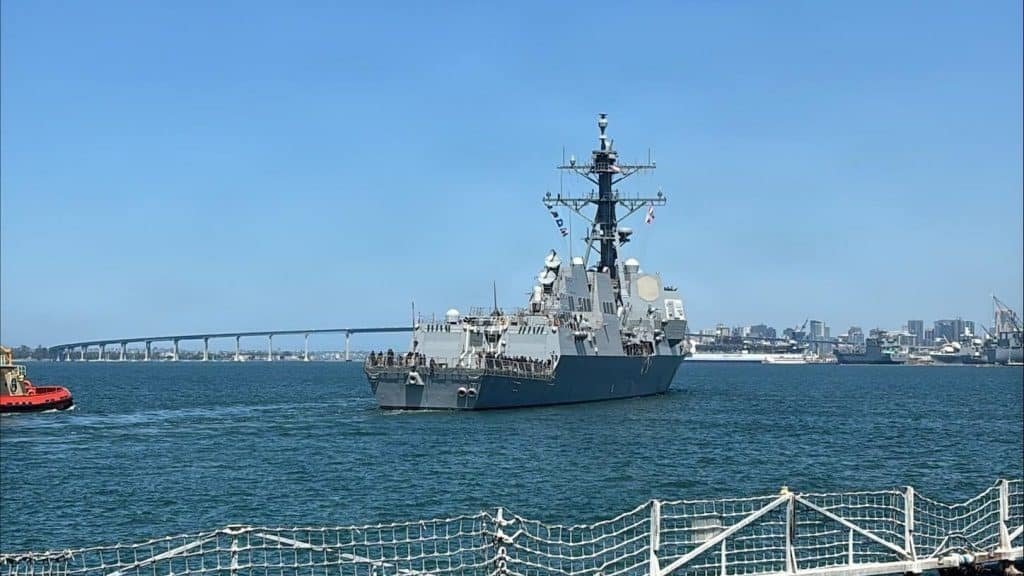
Naval Group signed a contract in Stockholm on Monday to build four defense and intervention frigates for the Royal Swedish Navy, less than four months after Sweden announced its selection of the French-designed FDI class.
The signing took place in the presence of French President Emmanuel Macron and Swedish Prime Minister Ulf Kristersson. Mikael Granholm, Director-General of the Swedish Defence Materiel Administration, signed on behalf of Sweden, while Pierre Éric Pommellet, Chairman and CEO of Naval Group, signed for the company. The deal followed exclusive negotiations between Naval Group and Sweden’s Ministry of Defence, conducted with support from the French government.
“I am delighted to be in Stockholm today to sign the contract for the delivery of four FDI frigates to Sweden, a major milestone in the cooperation between our two countries,” Pommellet said. “It is an honour to put our expertise at the service of the Swedish Royal Navy’s sovereignty and naval superiority, and I would like to thank the Swedish authorities for their trust. Naval Group is already fully involved and committed to the delivery of this major project.”
The FDI is a French-designed frigate already in service with the French and Hellenic navies, with two units delivered to date. Naval Group said the existing production line will allow it to meet Sweden’s requirement for rapid delivery, with the first Swedish frigate scheduled for 2030.
The frigate carries anti-air capabilities built around the ASTER missile system and is designed to operate in demanding maritime environments, including the High North, the Baltic Sea and the North Atlantic. Naval Group said the ships will support Sweden’s role in NATO and inter-allied naval operations.
Swedish Navy chief Rear Adm. Johan Norlén wrote in an opinion piece published the same day that the purchase reflects a changed mission for Sweden’s fleet since joining NATO. He said the Navy’s task has shifted from defending only Swedish territory to maintaining operational control over the Baltic Sea and its approaches, including protecting shipping bound for Finland and the Baltic states.
“Sweden’s Navy must now ensure that important shipping can reach us and our allies, such as Finland and the Baltic states,” Norlén wrote.
Norlén said the frigates’ size allows them to carry the weapons and sensors required for air defense against threats ranging from drones to ballistic missiles, and to remain on station for extended periods beyond the Baltic Sea. He addressed criticism that Sweden should invest solely in uncrewed systems, citing a recent meeting with his Ukrainian naval counterpart.
“Today Ukraine mainly uses drones because they lack other capabilities,” Norlén wrote. “They have achieved success in preventing Russia from using parts of the Black Sea for its purposes, but have greater difficulty ensuring the protection of their own shipping there.”
Naval Group said it will build a long-term industrial partnership with Swedish companies as part of the deal, including the transfer of know-how and technology to several Swedish partners.
Independent reporting takes resources. Join us on Patreon.
Sweden signs contract for four French-built frigates
Naval Group signed a contract in Stockholm on Monday to build four defense and intervention frigates for the Royal Swedish Navy, less than four months after Sweden announced its selection of the French-designed FDI class. The signing took ...
Haber Kaynağı & Doğrulama
Defence Blog Aviation
Kaynak Tarihi: 31 August 2026 – 21:24
Yayın Tarihi: 31 August 2026 – 21:24
Savunma360 Editoryal Notu & Stratejik Değerlendirme
Bu analiz, açık kaynaklı askeri istihbarat (OSINT), Savunma Sanayii Başkanlığı resmi envanter verileri ve bağımsız savunma analistlerimizin teknik değerlendirmeleri sentezlenerek hazırlanmıştır. Gelişmeler Türk Silahlı Kuvvetleri ve bölgesel kuvvet dengesi açısından yakından izlenmektedir.
Doğrulanmış Savunma Verisi
Orijinal Kaynak Bağlantısını İncele