The U.S. Air Force hopes to conduct more than 6,000 aircraft operations annually at four airfields on three American islands in the northwest Pacific Ocean, including a major WWII-era airfield that is being refurbished, according to an announcement from the Department of the Air Force.
The department published a notice of intent to prepare an environmental impact statement that will assess “potential social, economic, and environmental effects” of training and operations at Saipan International Airport, Tinian International Airport, Tinian North Field and Rota International Airport. The islands are part of the Commonwealth of the Northern Mariana Islands, an unincorporated U.S. territory.
The proposed training and exercises will support the Air Force’s Agile Combat Operations concept, which emphasizes dispersal of forces across airfields and the ability to maneuver between them while sustaining operations under a range of conditions, with the goal of thwarting an adversary’s ability to shut down those operations by targeting a single base. ACE, as it’s known, has developed largely in response to the Chinese military’s growing reach and expanding missile arsenal.
The notice said the four airfields provide “a unique opportunity” to support ACE, with infrastructure that varies from “fully developed commercial airfields to expeditionary operating locations.” The three islands are within a few dozen nautical miles of each other, which would allow for training that reflects the complexity of distributed operations while reducing transit time between them. They are less than 100 nautical miles north of the major military bases on Guam, another U.S. territory, which would support the staging and deployment of forces for those exercises.
The three airfields “collectively provide a training environment that enables [the Air Force] to exercise distributed operations, test and employ tailorable force packages, strengthen sustainment and maneuver capabilities, and enhance operational resilience,” the notice reads.
The environmental impact statement will evaluate the potential effects of the proposed activities, which include small, medium and large trainings and exercises held several times a year for a few weeks at a time and consisting of up to 1,200 fixed-wing and 320 rotary-wing operations, like takeoffs and landings, annually at each airfield. It will also assess an alternative scenario with up to 1,400 fixed-wing and 384 rotary-wing operations per airfield annually and a “No Action Alternative.”
The trainings and exercises would be supported by up to 550,000 gallons of fuel at each airfield, up to 1,000 personnel per airfield, the temporary installation of expeditionary infrastructure, the handling of munitions like chaff and flares, as well as support services and pre-and post-training and exercise activities.
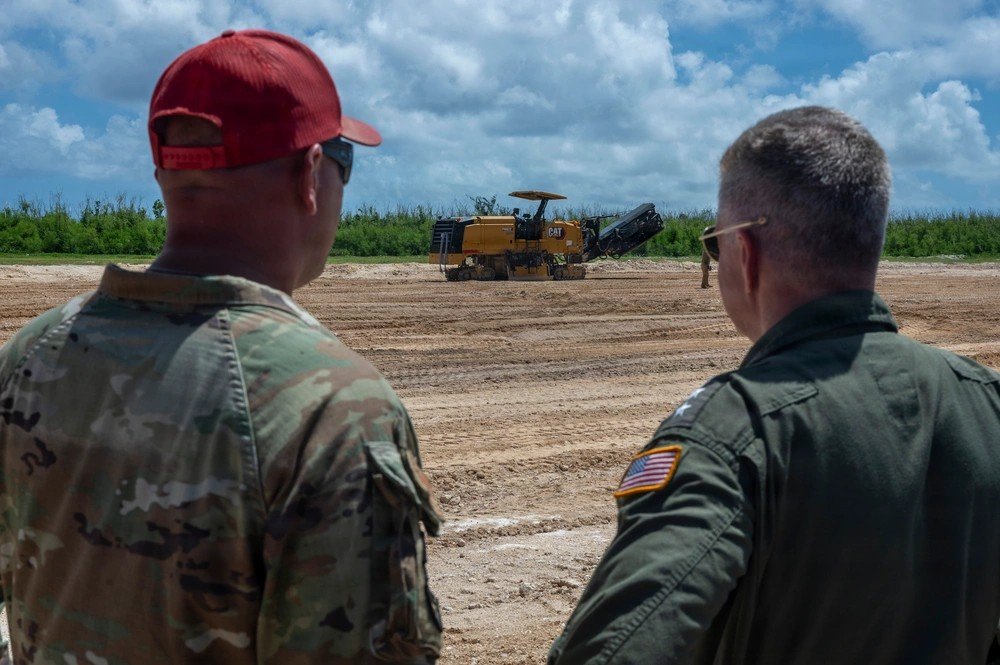
The proposed activity comes after several years of work to upgrade the airfields in question, especially the airfields on Tinian, which were built and heavily used during WWII. North Field was inactive after the war and was largely covered with vegetation when the rehabilitation effort began in late 2023. The Air Force also upgraded port and roadway infrastructure, fuel pipelines and airfield surfaces, and utilities to facilitate expanded operations on Tinian.
The airfield rehabilitation efforts have created some questions among Air Force leaders about resourcing and funding, particularly as the war with Iran has placed new demands on the force. Island residents also have misgivings about the projects. While some welcome the investment that the construction and military operations will bring, others have doubts that the increased activity will really benefit the islands’ populations and that the Pentagon will be transparent about its activity and responsive to local concerns.
The Department of the Air Force will hold public meetings this month on Saipan, Tinian and Rota to get feedback on the proposal, with written comments due by Nov. 29. The department plans to produce a draft environmental impact statement for public comment in fall 2027 and a final version in mid-2028.
US Air Force eyes reviving WWII air bases in the Pacific
The U.S. Air Force hopes to conduct more than 6,000 aircraft operations annually at four airfields on three American islands in the northwest Pacific Ocean, including a major WWII-era airfield that is being refurbished, according to an ann...
Haber Kaynağı & Doğrulama
Defense News Global RSS
Kaynak Tarihi: 06 November 2026 – 18:28
Yayın Tarihi: 06 November 2026 – 18:28
Savunma360 Editoryal Notu & Stratejik Değerlendirme
Bu analiz, açık kaynaklı askeri istihbarat (OSINT), Savunma Sanayii Başkanlığı resmi envanter verileri ve bağımsız savunma analistlerimizin teknik değerlendirmeleri sentezlenerek hazırlanmıştır. Gelişmeler Türk Silahlı Kuvvetleri ve bölgesel kuvvet dengesi açısından yakından izlenmektedir.
Doğrulanmış Savunma Verisi
Orijinal Kaynak Bağlantısını İncele