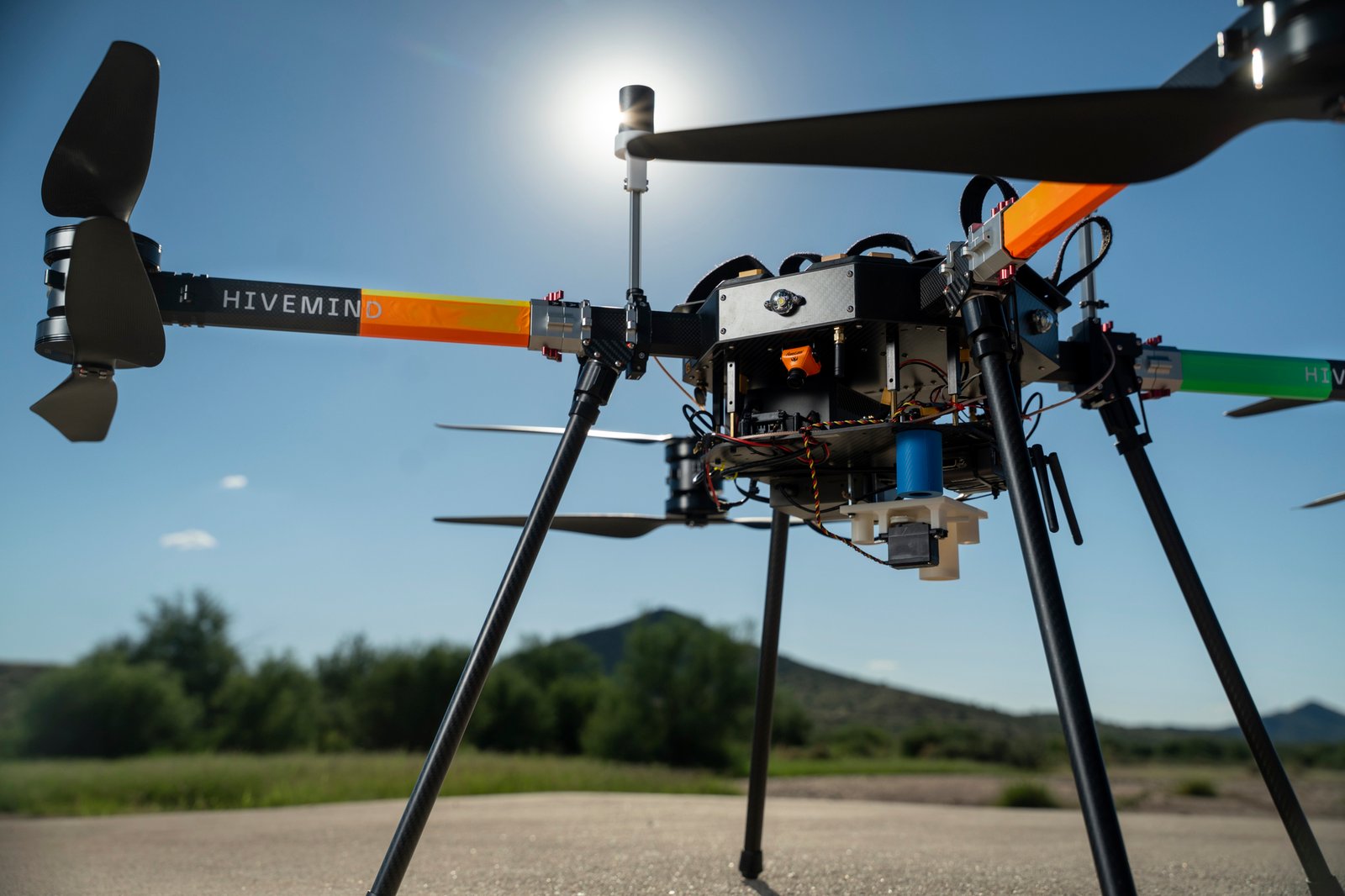
Cummings Aerospace has fired two of its 3D-printed Hellhound S3 jet-powered drones from a launcher mounted on a utility vehicle, with a single operator using one handheld controller to send both on separate autonomous missions, the company said. The test took place on Aug. 25, 2026, at the Pendleton UAS Range in Oregon, where an engineer from the Huntsville, Alabama-based company fired the two Hellhounds one after the other from a Polaris utility vehicle. Both carried inert payloads and flew different preplanned routes at different speeds, and Cummings Aerospace said the test met all of its objectives. The company announced the results on Oct. 12. It was the first time the Hellhound had been fired from a vehicle after more than a dozen flight tests in its man-portable configuration, and the first use of a new launcher that can hold up to eight of the drones. It was also the first ripple-fire of the S3 and the first time one operator controlled more than one Hellhound at once. Before launch, the operator programmed each drone’s waypoints, altitudes and flight path on the handheld fire control system. Once airborne, the Hellhounds flew those routes on their own while sending data back to the controller, so the operator could watch both flights live and change or abort either mission. “Instead of having to manually fly a single drone or effector to a target, one Soldier using one FCS can simultaneously put multiple Hellhounds on multiple targets,” said Sheila Cummings, the company’s CEO. The Hellhound S3 is about the size of a baseball bat and weighs about 6 kg (13 pounds). Its turbojet engine lets it fly more than 60 km (37 miles) at speeds of up to 618 km/h (384 mph), far faster than the propeller-driven quadcopters and loitering munitions common in Ukraine. Built from 3D-printed parts and commercial off-the-shelf components, it can be produced at a rate of more than 100 a month, according to the company. In its man-portable form, the drone, its launch canister and ground controller together weigh less than 11 kg (25 pounds), so one soldier can carry and launch it. Cummings Aerospace pitches the Hellhound as a multi-mission weapon that can work as a loitering munition, a precision-guided munition, a one-way attack drone or a counter-drone interceptor. Operators can swap between four mission modules, armor-piercing, blast-fragmentation, electronic warfare and decoy, in under two minutes without tools. “Controlling several S3s from one handheld system lets a small unit produce fires that used to take an entire battery,” said Cummings. The new multi-pack launcher can be lifted by two people and fitted to a range of crewed or uncrewed U.S. Army vehicles. Next, the company plans to salvo-fire the Hellhound from the launcher, then fire it from the launcher mounted on an uncrewed ground vehicle and on an uncrewed surface vessel at sea. Cummings Aerospace, a Native American woman-owned small business founded in 2009, first showed the Hellhound publicly at SOF Week in 2025, when it unveiled the turbojet strike drone and a larger S4 variant. The tube-launched S4 is 1.47 m (58 inches) long, weighs 20 kg (45 pounds) in its canister, can reach targets 130 to 140 km (81 to 87 miles) away and stay airborne for more than 1.5 hours, and the company is offering it as a low-cost cruise missile and as a gap-filling surveillance asset for the Golden Dome missile defense program.
U.S. firm fires cheap 3D-printed jet drones from a buggy
Cummings Aerospace has fired two of its 3D-printed Hellhound S3 jet-powered drones from a launcher mounted on a utility vehicle, with a single operator using one handheld controller to send both on separate autonomous missions, the company ...
Haber Kaynağı & Doğrulama
Defence Blog Aviation
Kaynak Tarihi: 19 October 2026 – 18:16
Yayın Tarihi: 19 October 2026 – 18:16
Savunma360 Editoryal Notu & Stratejik Değerlendirme
Bu analiz, açık kaynaklı askeri istihbarat (OSINT), Savunma Sanayii Başkanlığı resmi envanter verileri ve bağımsız savunma analistlerimizin teknik değerlendirmeleri sentezlenerek hazırlanmıştır. Gelişmeler Türk Silahlı Kuvvetleri ve bölgesel kuvvet dengesi açısından yakından izlenmektedir.
Doğrulanmış Savunma Verisi
Orijinal Kaynak Bağlantısını İncele