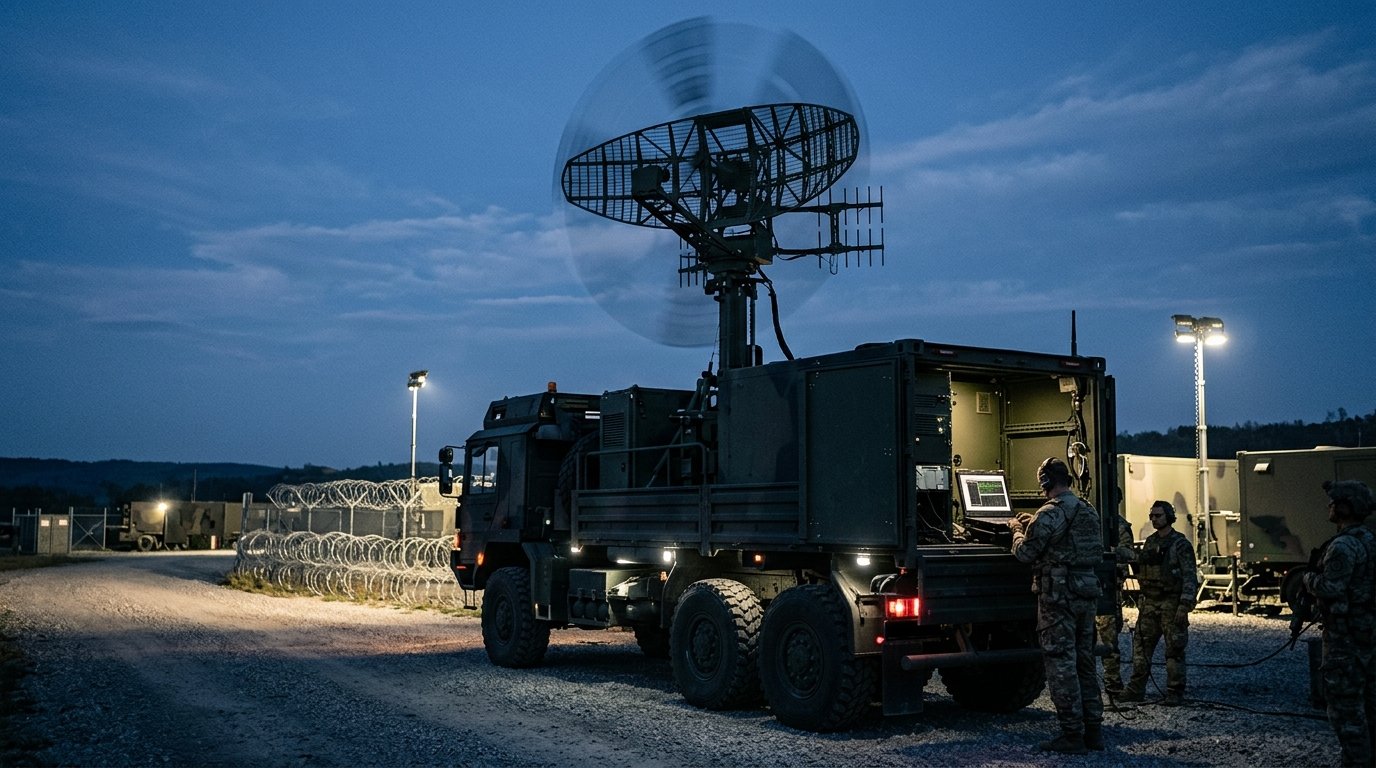
A new automated security system helped Marines detect and track a vehicle that strayed toward a live-fire range during a training exercise at Twentynine Palms, California, on Aug. 19, the U.S. Marine Corps said, marking one of the first real-world uses of a system built to replace hours of manual guard duty with radar and artificial intelligence.
The system, called the Mobile All-Domain Observation and Sensing System, or MA-DOSS, was operating in support of the installation’s Provost Marshal’s Office during Service Level Training Exercise 4-26. When a vehicle approached the edge of the exercise’s alert zone, MA-DOSS detected and classified it automatically, alerting two Marine operators inside a command post. The operators confirmed the intrusion on their monitors and passed the tracking data to range safety personnel, and the live-fire event continued without interruption.
MA-DOSS pairs radar and camera sensors with artificial intelligence and machine learning software built to spot and classify targets across air, land and littoral domains at once. The system processes that data on site rather than streaming continuous video over tactical networks, which the Marine Corps says keeps bandwidth demands low while still filtering out background clutter from genuine incursions. The underlying models continue learning from what they detect, a process the program office runs in coordination with the Pentagon’s Chief Digital and Artificial Intelligence Office, with the goal of cutting down false alarms over time.
“[AI implementation] is going to help us not just learn what the enemy’s already thrown at us, but learn what new systems may come our way in different ways and how the enemy may employ them,” said Capt. Griffen Hedrick, MA-DOSS project officer for Program Manager Ground-Based Air Defense. “So it’s not just a giant library of what they’ve done before, but predictions of the future.”
The system is meant to replace the Ground-Based Operational Surveillance System, or G-BOSS, a network of trailer-mounted towers up to 107 feet tall that the Marine Corps has used for years to watch over installations and forward bases. Those towers provide steady surveillance but are heavy and fixed in place once erected. MA-DOSS, by contrast, needs only two Marines and about 30 minutes to set up, according to the Marine Corps.
Program Manager Ground-Based Air Defense fielded two MA-DOSS Medium prototypes now in use after working with the Pentagon’s Defense Innovation Unit and drawing on funding from the Physical Security Enterprise Analysis Group, a path meant to move faster than the traditional acquisition process. MA-DOSS is not currently an official program of record, and the Marine Corps described the Twentynine Palms demonstration as evidence supporting the case for further investment rather than confirmation of a formal program.
“In traditional security setups, maintaining that level of persistent, multi-domain awareness forces Marines to spend endless hours fixed to surveillance monitors,” said Master Sgt. Daniel Sloniker, operations chief for the Twentynine Palms Provost Marshal’s Office. “By automating detection and cueing the cameras directly to the threat, MA-DOSS eliminated screen fatigue and served as a true force multiplier, freeing our trained military policemen from passive observation so they could focus on dynamic patrols and rapid tactical response.”
Independent reporting takes resources. Join us on Patreon.
U.S. Marines test new AI-driven automated security system
A new automated security system helped Marines detect and track a vehicle that strayed toward a live-fire range during a training exercise at Twentynine Palms, California, on Aug. 19, the U.S. Marine Corps said, marking one of the first rea...
Haber Kaynağı & Doğrulama
Defence Blog Aviation
Kaynak Tarihi: 18 September 2026 – 10:18
Yayın Tarihi: 18 September 2026 – 10:18
Savunma360 Editoryal Notu & Stratejik Değerlendirme
Bu analiz, açık kaynaklı askeri istihbarat (OSINT), Savunma Sanayii Başkanlığı resmi envanter verileri ve bağımsız savunma analistlerimizin teknik değerlendirmeleri sentezlenerek hazırlanmıştır. Gelişmeler Türk Silahlı Kuvvetleri ve bölgesel kuvvet dengesi açısından yakından izlenmektedir.
Doğrulanmış Savunma Verisi
Orijinal Kaynak Bağlantısını İncele