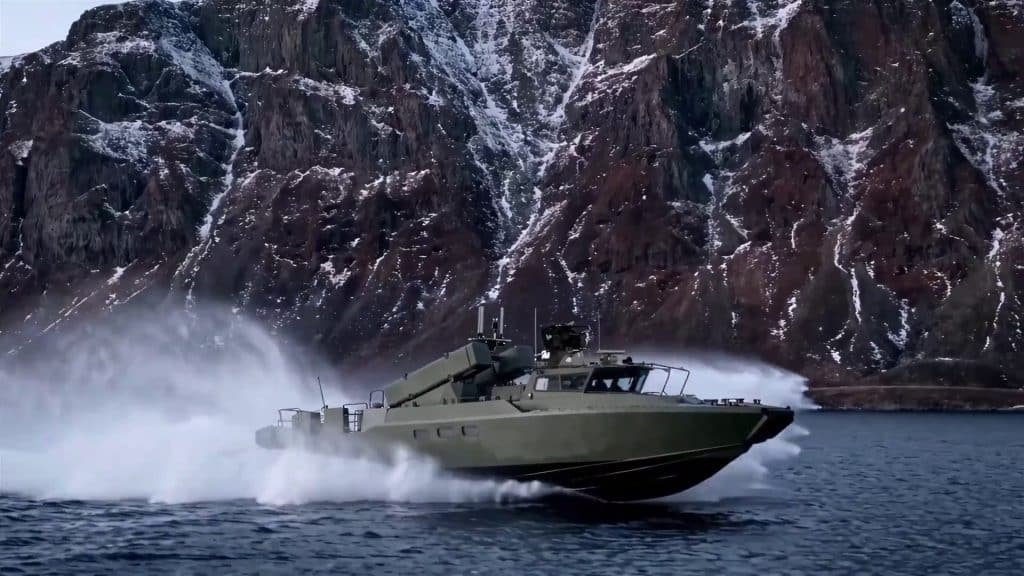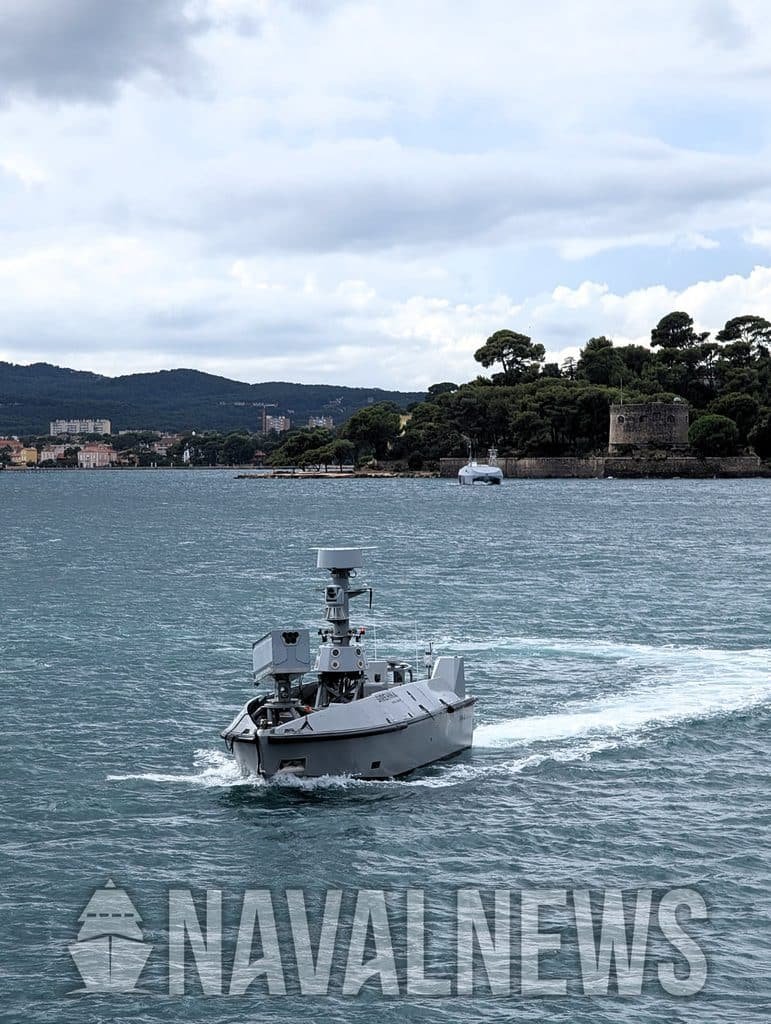
During the Euronaval 2026 press tour, Naval Group’s Sirehna conducted a live demonstration of the SEAQUEST-S, a multi-role combat USV designed for deployment from warships.
Sirehna, a subsidiary of Naval Group, offered a rare opportunity to the 25 journalists representing 16 nationalities who attended the tour: a live demonstration of SEAQUEST-S, a multi-role combat small uncrewed surface vehicle (USV) designed for deployment from warships. The compact platform can carry a wide range of weapons, sensors and electronic equipment, extending the operational capabilities of its mothership.
Combining modularity, high speed and long endurance in a compact design, SEAQUEST-S can be deployed from frigates without requiring modifications to the host ship, using its existing launch and recovery system (LARS). When integrated with the STEERIS mission system (MS), it enables frigates to operate a hybrid fleet of crewed and uncrewed platforms across the maritime and aerial domains. This approach supports a broad range of combat missions, including identification, surveillance, reconnaissance, tracking and targeting (ISRT-T), as well as direct-attack missions.
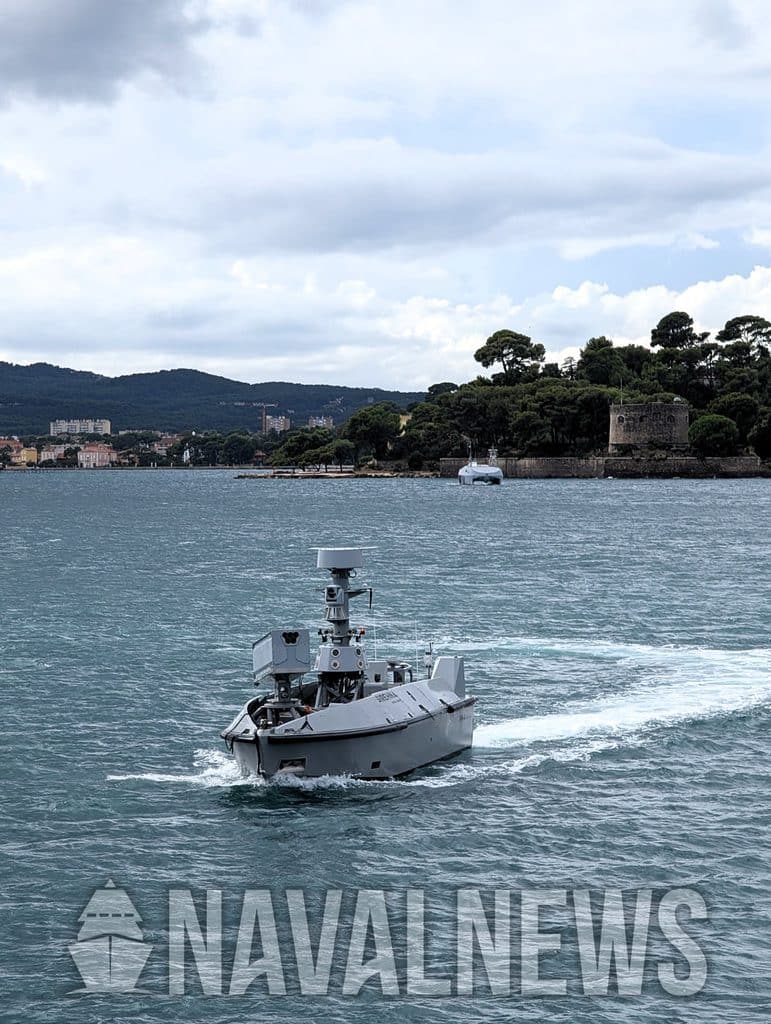
SEAQUEST-S Specifications
The SEAQUEST-S measures 9.3 meters in length, has a beam of 2.9 meters, and weighs approximately six tonnes. It is powered by a 475hp engine coupled with a waterjet propulsion system, giving it a maximum speed of 35 knots. Its 460-liter fuel capacity provides a range of 220 nautical miles (expendable up to 530nm), and the USV can operate in sea conditions up to Sea State 5.
The USV features precise navigation through an integrated INS, GNSS and DVL suite, with both remote-controlled and autonomous operating modes. It supports real-time and delayed data transfer via Wi-Fi, GSM, SATCOM and radio links, as well as line-of-sight (LOS) and beyond-line-of-sight (BLOS) communications. Sensitive mission data can be stored securely using cyber-protected onboard storage.
The hull is constructed entirely of composite materials. SEAQUEST-S features a retractable panoramic sensor integrated mast (PSIM) for mission and navigation systems ( day/night cameras, AIS, COMINT, electro-optical sensor, navigation equipment), while its forward payload bay can accommodate a variety of mission-specific equipment and weapons. These range from rockets and missiles for engaging land and surface targets to torpedoes and depth charges for anti-submarine warfare (ASW) missions.
Designed for ease of maintenance, SEAQUEST-S can primarily operate as a forward-deployed sensor platform, collecting data and providing situational awareness well beyond the host ship. This extends the frigate’s surveillance capabilities while reducing the need to expose the crewed platform to potential threats.
Weapon Payloads and RAMPART CIWS
One of SEAQUEST-S’s most interesting features is its dedicated forward payload area, which can accommodate a variety of removable mission-specific modules, including offensive systems. These include remotely trainable and fixed launchers for guided or unguided rockets, missiles, depth charges and ASW decoys, as well as small torpedoes fitted on racks or small containers carrying loitering munitions, sonobuoys or kamikaze UAVs.
The USV on display was fitted with a launcher incorporating a single module of the type used by the RAMPART modular close-in weapon system (CIWS), which can accommodate up to four such modules. The single module fitted to SEAQUEST-S was configured for 15 rocket launchers.
STEERIS Mission System for Drones
STEERIS MS manages the missions of any drone or autonomous system incorporated into a naval force from end to end. It is interfaced with the vessel’s Naval Group SETIS combat management system (CMS), as part of naval collaborative combat. Its interface is easy to use and requires only one operator for mission planning, supervision and reporting from a common multifunction console in the ship’s Combat Information Centre (CIC).
The post Video: Naval Group Demonstrates Armed SEAQUEST-S USV appeared first on Naval News.