CHRISTCHURCH, New Zealand — Australian military officials have been furtive about how they will use Anduril-developed Ghost Shark extra-large autonomous underwater vehicles – or XLAUVs. However, they recently lifted the lid on some payloads the Royal Australian Navy is fielding.
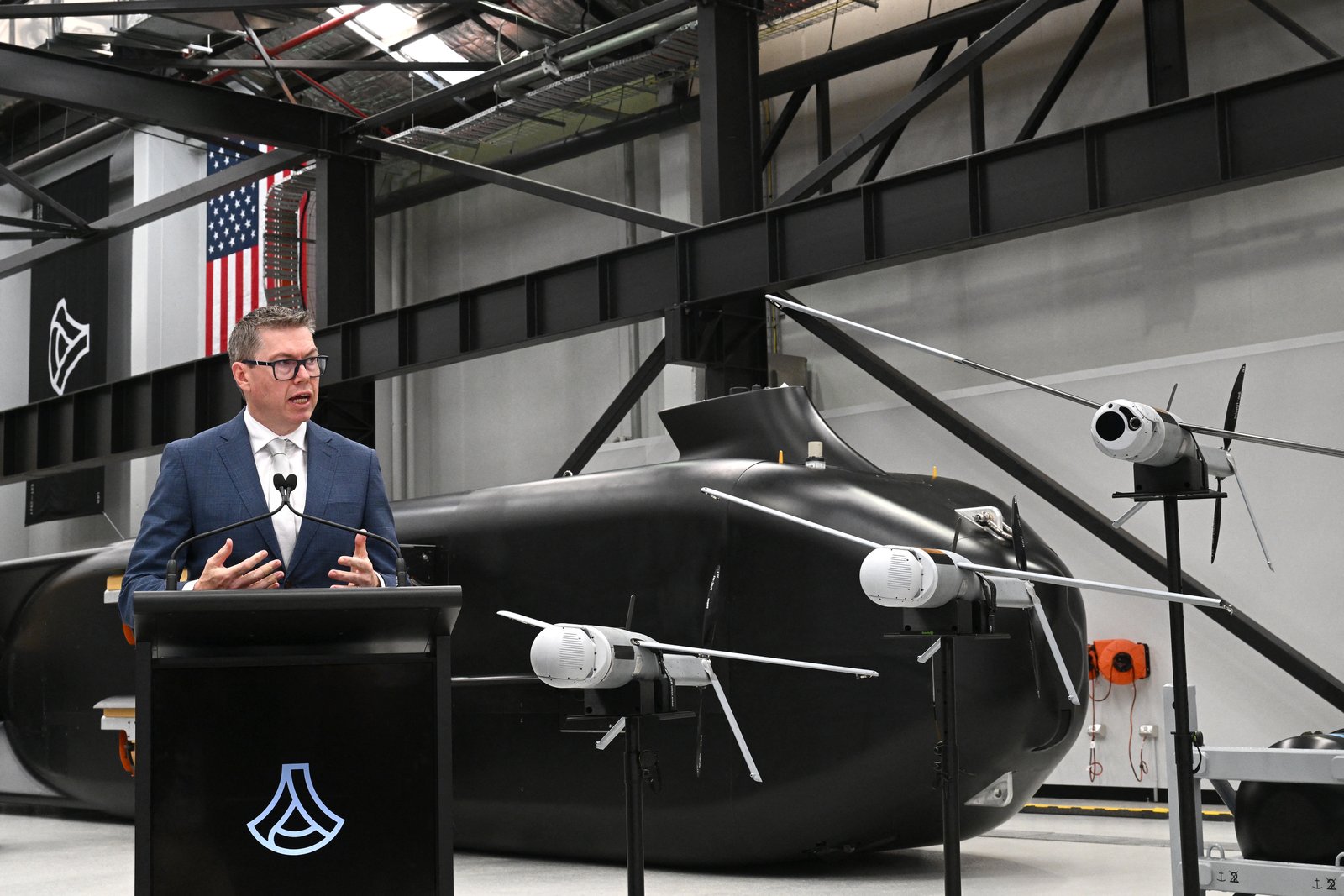
In an official unveiling at Anduril Australia’s manufacturing center in Sydney on Oct. 19, three Ghost Shark payloads were revealed.
One entailed sea mines, another was a swarm of Altius-600 loitering munitions, and the third was logistics supply caches.
In other words: Two of the three payloads comprise kinetic effectors to give the Ghost Shark greater bite.
This means a single XLAUV can clandestinely deploy a dozen sea mines, perhaps in maritime chokepoints during a conflict.
Meanwhile, Anduril’s Altius weapons can perform both surveillance and strike.
Regarding the supply caches, an official said, “Let’s just say, people can use their imagination about the sort of forces that would use these on deployment.”
The Department of Defence said in a press release: “The modular design of these platforms allows them to operate a range of different payloads, customized to the required mission.”
Other payloads are being developed for the Ghost Shark, likely involving lightweight and heavyweight torpedoes, as well as electronic warfare.
Ghost Sharks can deploy from shipping containers, off the stern of relatively small ships or from wharves, Minister for Defence Industry Pat Conroy explained.
“It places question marks in adversaries’ minds,” he said.
With Australia having to wait years for nuclear-powered submarines to arrive, autonomous underwater systems like the Ghost Shark can fill capability gaps as six aging Collins-class diesel-electric submarines continue to plod along.
Anduril Australia opened its factory less than a year ago, and “Ghost Sharks capable of a range of complex missions operating far from our shores are now rolling off the line at an increasing rate into the hands of the Australian navy,” Conroy said.
Canberra is spending A$1.7 billion (US$1.2 billion) on its fleet of Ghost Sharks. This amounts to “dozens and dozens” of XLAUVs, but Australia is not saying how many exactly.
The Royal Australian Navy is also fielding the smaller Speartooth XLAUV from Australian firm C2 Robotics.
Navy Chief Vice Adm. Matt Buckley said: “In terms of our platforms themselves, of course they must continue to evolve, and the evolution of modular payloads that we can fit to uncrewed vessels like the Ghost Shark … creates enormous flexibility for us and allows us to adapt these systems to future missions and future requirements.”
He added: “Our purpose is clear – we need to deliver capability at the speed of relevance, strengthen our ability to conduct undersea warfare and seabed operations, contribute to sea denial and help protect our critical undersea infrastructure.”
The Ghost Shark and its payloads have participated in the past few Maritime Big Play Pacific events, including one in San Diego in October.
The first Ghost Shark was handed over to the Australian Navy for testing and acceptance in early 2026.
Australia unveils secretive Ghost Shark underwater drone payloads
CHRISTCHURCH, New Zealand — Australian military officials have been furtive about how they will use Anduril-developed Ghost Shark extra-large autonomous underwater vehicles – or XLAUVs. However, they recently lifted the lid on some payload...
News Source & Verification
Defense News Global RSS
Source Date: 02 November 2026 – 11:00
Published: 02 November 2026 – 11:00
Savunma360 Editorial Note & Strategic Assessment
This report is synthesized using open-source defense intelligence (OSINT), official inventory telemetry, and technical evaluations by independent defense analysts.
Doğrulanmış Savunma Verisi
Orijinal Kaynak Bağlantısını İncele