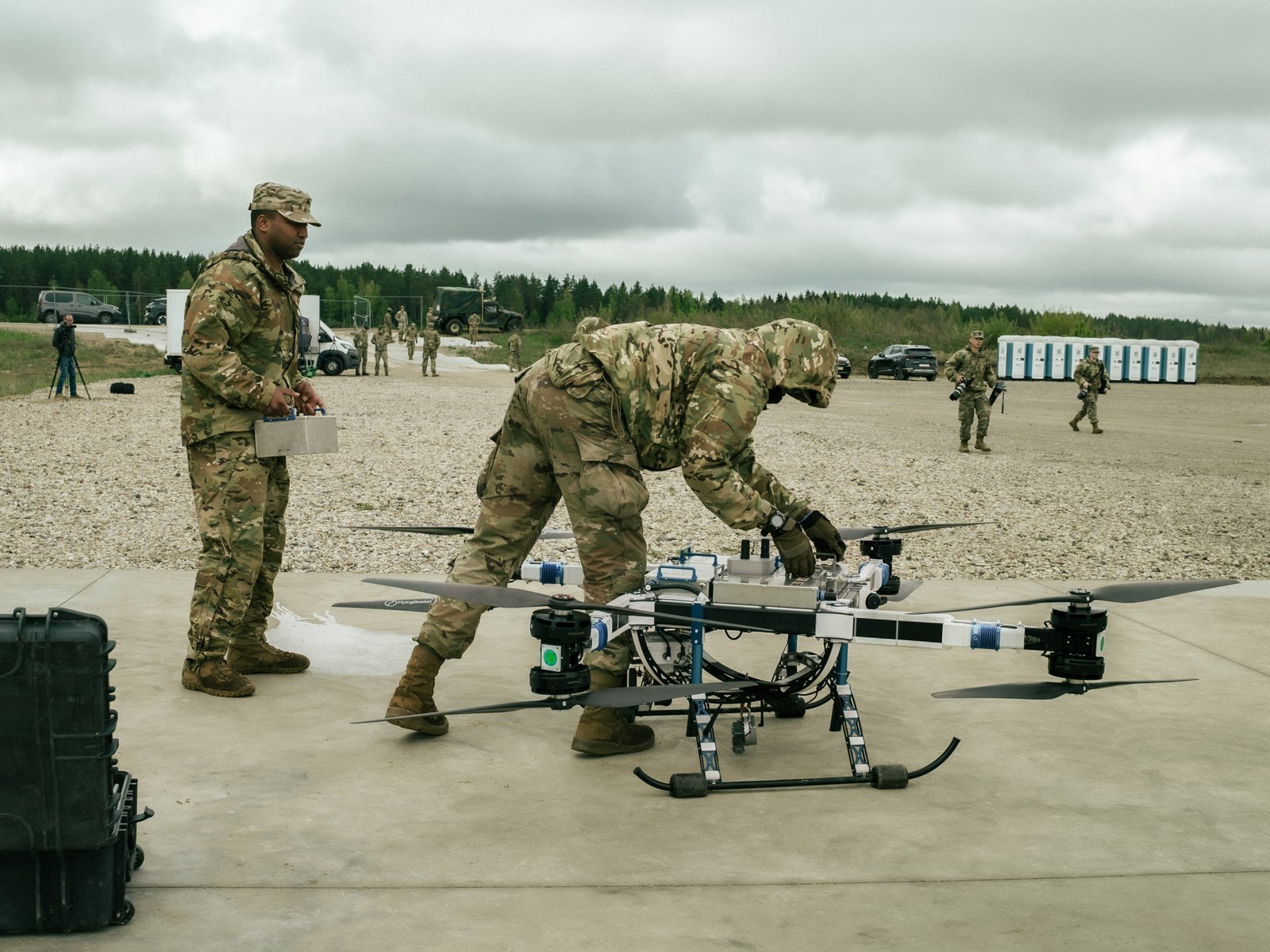
A counter-drone startup tested a low-cost interceptor missile at Yuma Proving Ground this month, loading it into an eight-shot launcher during a homeland-defense experiment involving U.S. Northern Command, NORAD and the Pentagon’s Joint Interagency Task Force 401.
Perseus Defense, a company that went through Y Combinator’s 2025 batch, said each Mk-III interceptor it fired cost roughly $2,500 to build. The company demonstrated the system to a group of distinguished visitors at the test event, showing the launcher running what it described as Lattice-level integration, a reference to Anduril Industries’ command-and-control software, following an earlier demonstration at Fort Carson’s Operation Jailbreak exercise.
The Mk-III is built to physically strike small drones rather than jam or spoof their signals, a kinetic hit-to-kill approach the company says is harder to defeat than electronic warfare against drones flying on fiber-optic links or preprogrammed waypoints that don’t rely on jammable radio signals. Perseus has said it is targeting a cost per engagement far below the $100,000-plus kinetic interceptors currently used against drones that themselves can cost as little as a few hundred dollars.
The push for that kind of low-collateral kinetic option traces back to a specific incident. In December 2023, dozens of unidentified drones flew over Joint Base Langley-Eustis in Virginia, forcing the base to temporarily relocate its F-22 fighters and exposing gaps in how U.S. installations could legally and physically respond to drone incursions over American soil. Similar sightings followed at other bases into 2024 and 2025, and the Department of War stood up JIATF-401 in 2025 specifically to speed up counter-drone capabilities for U.S. forces and installations at home.
The Perseus system was fired at Cibola Range Site 17, Yuma Proving Ground, as part of Falcon Peak 26.2, a counter-small unmanned aircraft systems experiment run by the North American Aerospace Defense Command and U.S. Northern Command. The exercise is designed to demonstrate new counter-drone technologies, expand the military’s focus on low-collateral defeat capabilities, deepen collaboration with mission partners, and give developers fast feedback to speed up the maturity of systems with potential use across the Department of War. This was the first time the campaign was held at Yuma Proving Ground rather than its previous home at Eglin Air Force Base. Other reporting on the event described a Perseus interceptor called Harpe, a 61-centimeter missile with a stated 2-kilometer engagement range fired from a launcher weighing less than 36 kilograms (79 pounds), tested alongside other short-range counter-drone systems to help U.S. Northern Command weigh mobility, cost per shot and magazine depth for base defense.
Perseus Defense was founded in 2025 by Jason Cornelius and Steve Messinger, who studied aerospace engineering together at Penn State, and the company has raised $6.5 million in seed funding.
Independent reporting takes resources. Join us on Patreon.
U.S. Army tests a cheap missile made to intercept drones
A counter-drone startup tested a low-cost interceptor missile at Yuma Proving Ground this month, loading it into an eight-shot launcher during a homeland-defense experiment involving U.S. Northern Command, NORAD and the Pentagon’s Joint Int...
News Source & Verification
Defence Blog Aviation
Source Date: 18 September 2026 – 11:02
Published: 18 September 2026 – 11:02
Savunma360 Editorial Note & Strategic Assessment
This report is synthesized using open-source defense intelligence (OSINT), official inventory telemetry, and technical evaluations by independent defense analysts.
Doğrulanmış Savunma Verisi
Orijinal Kaynak Bağlantısını İncele