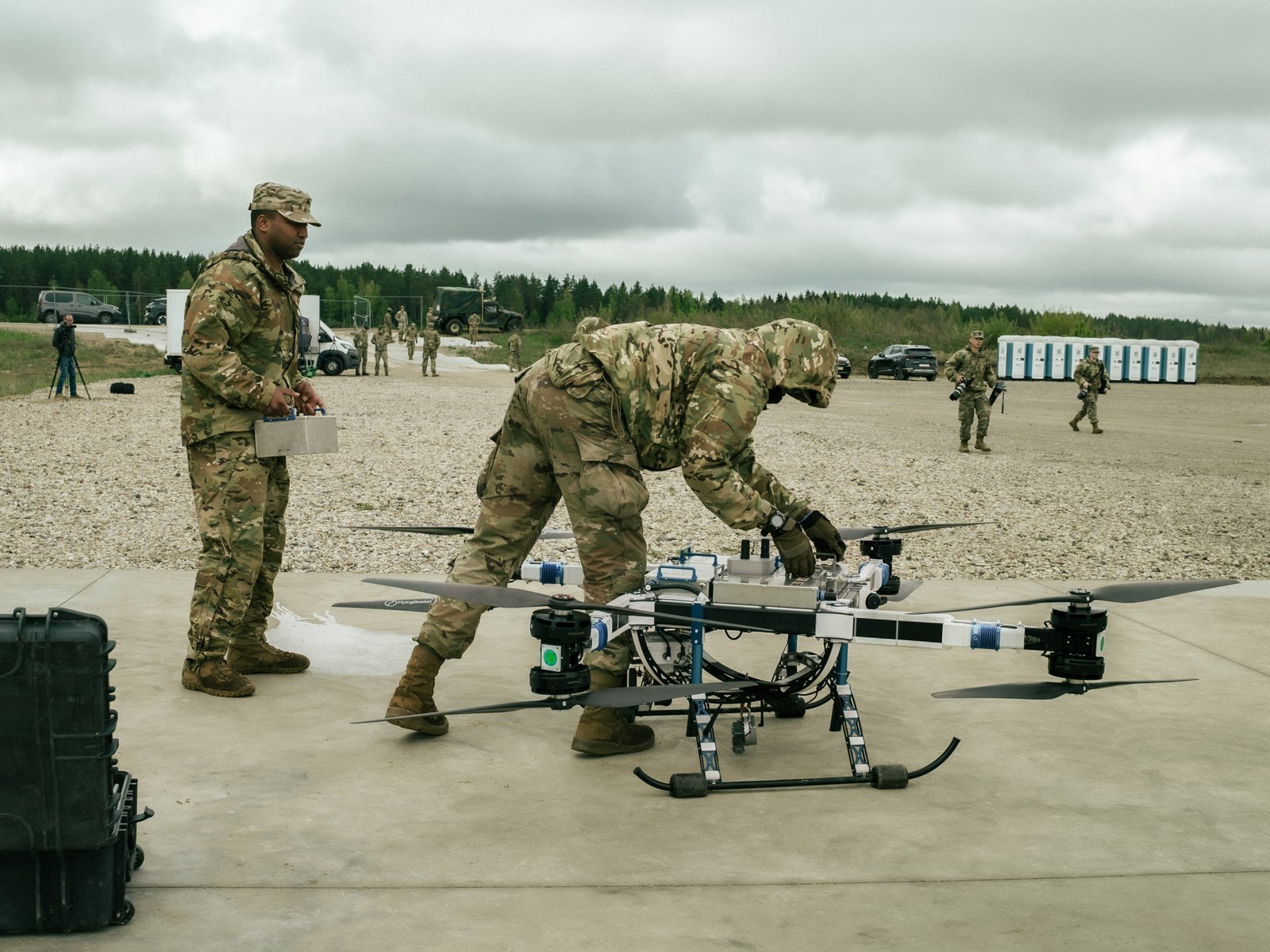
U.S. Soldiers and Army capability developers spent two weeks at Fort Benning testing drones that stay tethered to the ground, aiming to give small infantry units a way to see farther and keep radios working even when the terrain or enemy jamming gets in the way.
The Maneuver Battle Lab ran the assessment from July 27 to Aug. 7 at the post’s McKenna Field Landing Site, putting two commercial tethered unmanned aircraft systems, known as Te-UAS, through static tests, moving tests and emergency scenarios. The lab worked with the Army’s Air Robotics office, its Dismounted Requirements Branch, the Maneuver Future Capability Directorate and Product Lead Strategic Spectrum Warfare to design and run the trial.
A tethered drone stays connected to a ground vehicle or station by a physical cable that supplies continuous power and carries data both ways, so the aircraft never has to land for a battery swap and can theoretically stay airborne indefinitely. During the Fort Benning tests, the drones climbed to altitudes the Army considers operationally useful, and evaluators timed how fast they could go up and come back down. One test tracked a drone in “follow mode” as it stayed positioned above an Infantry Squad Vehicle-Utility moving through the training area, an Army light transport built by GM Defense to carry nine soldiers across terrain too rough for a Humvee or Joint Light Tactical Vehicle. Operators used the drones to bounce communications signals around terrain obstacles, work around signal jamming, and spot targets from a safer distance than they could on the ground.
“The Maneuver Battle Lab’s mission is experimentation,” said Tollie Strode Jr., government oversight lead for the assessment and unmanned systems team chief at the lab. “We take technology to the field, employ it in an operational context, look under the hood, kick the tires and report what we find to inform programmatic decisions.”
“This is a great opportunity for long-endurance mission sets,” said Capt. Sarah Runion, executive officer of the lab’s Live Experimentation Branch, who took part in the assessment. “Tethered UAS bring a lot of pros to the force: we don’t have to worry about battery life or anything like that, which you see on other drones. It can go through different levels of height, and it can follow you along on whatever platform you deem it on.”
Evaluators also looked at how easy the systems were to operate without extensive training. “In a matter of minutes, I was able to get [the drone] launched up in the air … and then it’s a quick, easy one-step button to bring it back down,” Runion said. “This has been a user-friendly experience.”
Mark Pagliaro, a contractor with Product Lead Strategic Spectrum Warfare, compared the setup to a mobile version of a fixed surveillance tower. “It’s similar to a very high tower,” Pagliaro said. “Having a sensor up that high in their [area of operations] is going to influence [the maneuver unit] and allow them to extend ranges and see targets farther.” He added that the simple launch process leaves operators free to focus on incoming camera feeds and data rather than piloting the aircraft.
The Maneuver Battle Lab is now compiling soldier feedback, technical performance data and details on the systems’ operational footprint into a final report for Army decision-makers. “When we develop a clear concept of operation and employment, it gives us credibility behind the numbers and information we provide to decision-makers,” Strode said. “It answers the ‘so what?’ and provides the essential analytical underpinning to determine if this technology should transition into a permanent Army program of record.”
Independent reporting takes resources. Join us on Patreon.
U.S. Army tests tethered drone on a light squad vehicle
U.S. Soldiers and Army capability developers spent two weeks at Fort Benning testing drones that stay tethered to the ground, aiming to give small infantry units a way to see farther and keep radios working even when the terrain or enemy ja...
Haber Kaynağı & Doğrulama
Defence Blog Aviation
Kaynak Tarihi: 18 September 2026 – 10:23
Yayın Tarihi: 18 September 2026 – 10:23
Savunma360 Editoryal Notu & Stratejik Değerlendirme
Bu analiz, açık kaynaklı askeri istihbarat (OSINT), Savunma Sanayii Başkanlığı resmi envanter verileri ve bağımsız savunma analistlerimizin teknik değerlendirmeleri sentezlenerek hazırlanmıştır. Gelişmeler Türk Silahlı Kuvvetleri ve bölgesel kuvvet dengesi açısından yakından izlenmektedir.
Doğrulanmış Savunma Verisi
Orijinal Kaynak Bağlantısını İncele